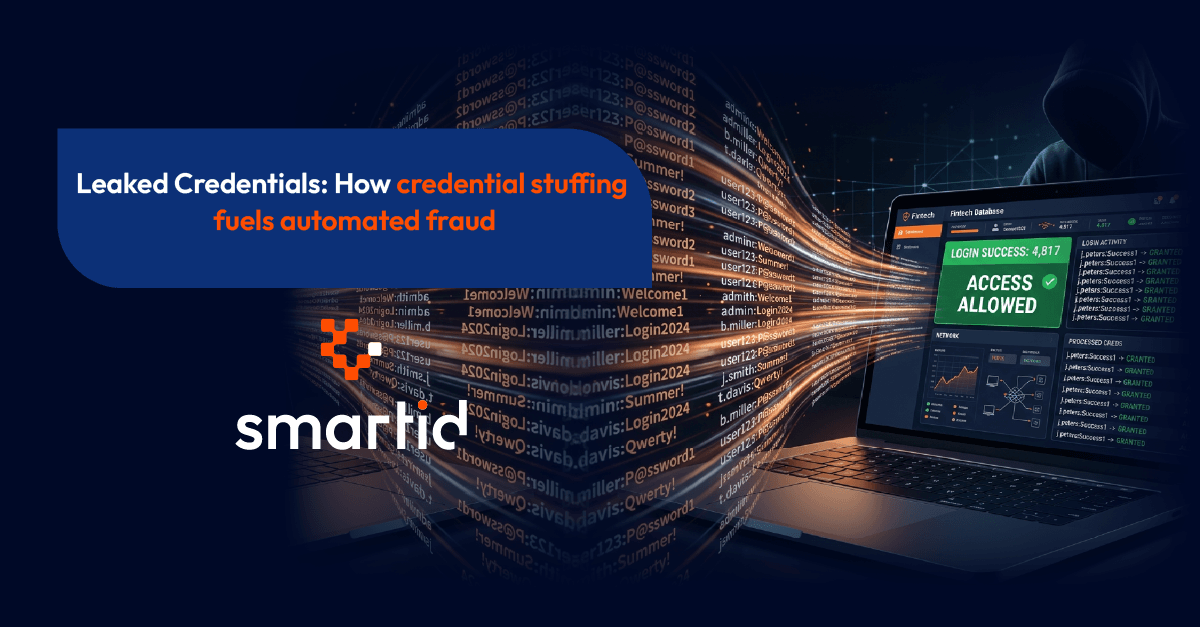
Credential stuffing is an automated fraud technique in which attackers use username and password combinations obtained from data breaches to attempt to log in to other digital services.
This type of attack exploits a common behavior: the reuse of passwords across different platforms. If a user uses the same password on multiple services, a leaked credential from one site can grant access to multiple accounts on others.
How the Attack Works
Attackers collect large databases of leaked credentials available on underground forums or data marketplaces. They then use automated tools and proxy networks to test millions of username and password combinations against login portals.
Unlike brute-force attacks, credential stuffing uses real credentials, significantly increasing the likelihood of success.
To circumvent traditional controls, attackers often employ:
- Automated bots that execute thousands of simultaneous login attempts
- IP and proxy rotation to evade address-based blocking
- Simulating legitimate traffic to appear as normal user activity
As a result, many login attempts may appear as valid logins from the system's perspective.
A real-world example: the Dunkin' attack
A well-known example occurred when Dunkin' suffered a credential stuffing attack against customer accounts.
Attackers used credentials leaked in external data breaches and automated login attempts against the platform. When a combination matched, they gained access to the user's account.
In several cases, the criminals used the reward points accumulated in the accounts to make fraudulent purchases or transfer benefits to other accounts.
This incident demonstrated that organizations can be compromised without their own systems being directly breached, but rather through compromised credentials on other services.
Implications for Digital Security
Credential stuffing remains a widely used technique because it combines automation, large volumes of leaked credentials, and insecure user habits.
Traditional defenses such as login attempt limits or IP blocking are often insufficient against distributed attacks. Detecting these scenarios requires analyzing behavioral patterns, access context, and device integrity to identify automated or anomalous activity before an account is compromised.
In this context, solutions like SmartID allow you to detect automation signals, assess the risk of each login attempt, and block suspicious access before it becomes an account takeover.