Blog
Identity Assurance Levels: How Much Identity Confidence Does Each Transaction Require?
Checking a balance, updating a contact email, and transferring a large sum to a new account are actions that, on many digital platforms, undergo very similar validation processes. However, the risk associated with each of these actions is completely different. This is precisely the problem that Identity Assurance Levels (IAL) aim to solve.
4 min read
Cybersecurity in 2026: Key Practices Every Financial Institution Should Strengthen
Every October, the world puts cybersecurity back at the center of the conversation. For a financial institution, the challenge is also to bring these principles into the protection of its digital channels.
4 min read
When AI Starts Making Payments: The New Challenge of Trusting a Machine
The next transformation in payments won't just be about making transactions faster; it will be about allowing artificial intelligence to act on our behalf.
4 min read
AI vs. AI: The Tech Race Between Attackers and Anti-Fraud Teams
For years, artificial intelligence has been touted as a technology capable of transforming fraud detection. Analyzing vast amounts of data, identifying anomalies, and recognizing patterns that are difficult to spot manually are among its most obvious applications. But there is another side to this evolution.
4 min read
Digital Identity Attacks: How Fraud Evolves Without Stealing a Document
When people think of identity fraud, the most common image is that of an attacker stealing a document or credentials to impersonate a real person. However, a growing share of modern attacks no longer relies on that scheme. A digital identity can be compromised without a single piece of sensitive data being stolen.
4 min read
Identity Risk: How to Evaluate if a Digital Identity Is Truly Trustworthy
A valid document doesn't always mean a low-risk identity When an organization evaluates whether to approve an account, a loan, or a transaction, it often relies on a seemingly simple question: Is the presented document valid? But that question alone leaves out an essential component of the decision: the real risk associated with that identity.
Identity Proofing vs. Identity Verification: Key Differences for Fraud Prevention
In the conversation about digital identity, two terms are frequently used interchangeably: identity proofing and identity verification. However, they represent distinct stages in the trust process, and confusing them can lead organizations to assume they are more protected than they actually are.
4 min read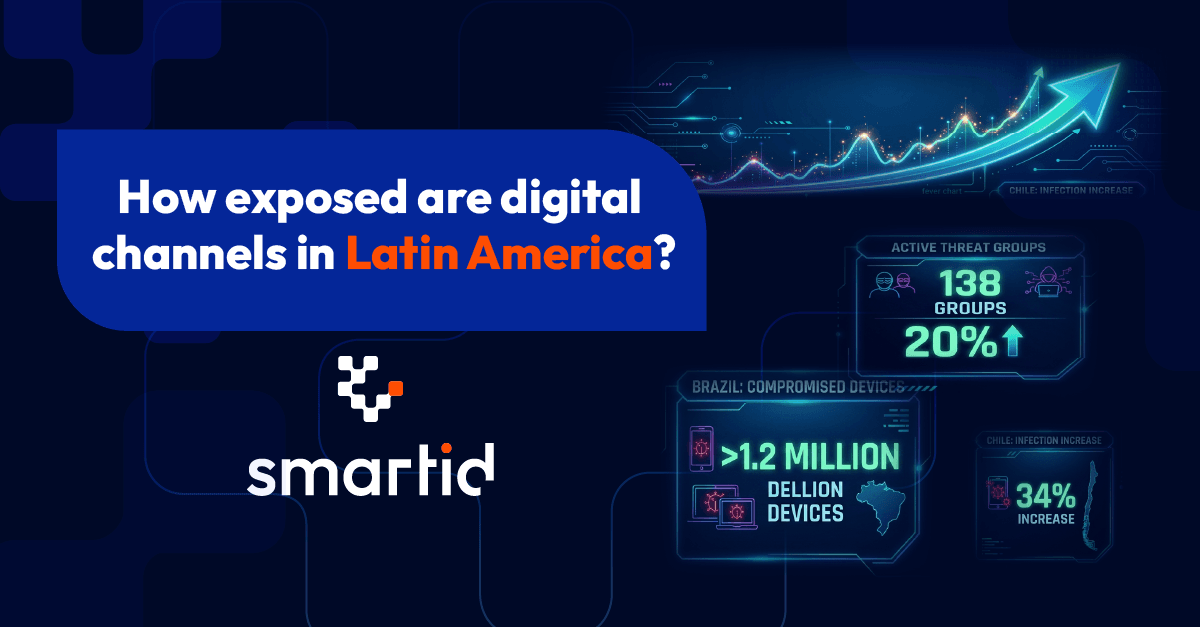
5.000 Cybersecurity in LATAM 2026: The Threats Redefining Digital Risk
Latin America has become an increasingly attractive target for cybercrime groups. The rapid digitization of financial services, e-commerce, and digital channels has expanded the attack surface, while criminal groups have professionalized their operations using ransomware-as-a-service, infostealers, and increasingly scalable attack models.
4 min read
Malware in Latin America: What the Threats Compromising the Region Reveal
Malware continues to evolve in Latin America, but one of the most relevant findings lies not only in the families detected, but also in the patterns that are repeated across different countries.
4 min read
From Rule Engines to Explainable AI: How Risk Decisions Are Evolving in Banking
For decades, risk decisions in financial institutions were dominated by rule engines. If a transaction exceeded a certain amount, originated from an unusual location, or violated a specific policy, the system responded with a predefined actio
4 min read
Injection Attacks in 2026: Why They Remain a Leading Cause of Security Breaches
Technologies evolve. Programming languages change. Architectures migrate toward microservices and APIs. However, injection attacks remain one of the most widely used techniques by cybercriminals to compromise applications and access sensitive information.
4 min read
When the Victim Installs the Attacker: The Rise of Remote Access Fraud in Latin America
Instead of breaking into a system, attackers convince victims to install legitimate remote access applications themselves. Once installed, these tools provide criminals with direct control of the device, allowing them to observe user activity, manipulate online banking sessions and authorize fraudulent transactions in real time.
4 min read