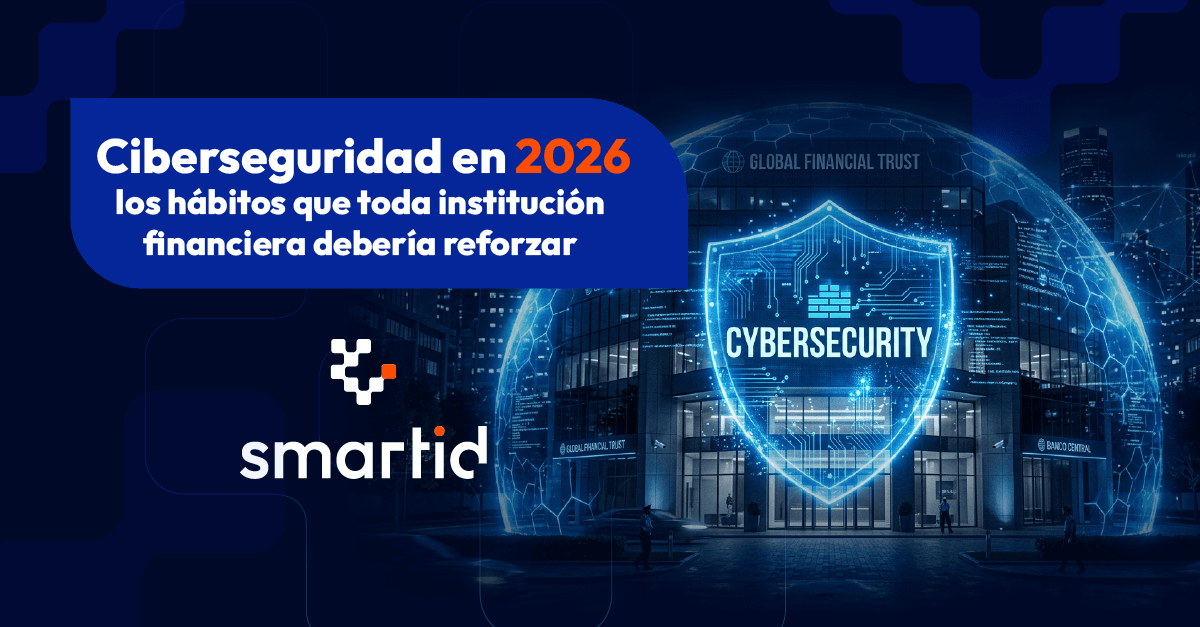
Cybersecurity in 2026: Key Practices Every Financial Institution Should Strengthen
By SmartID · security
Every October, governments, businesses, and international organizations take part in Cybersecurity Awareness Month, an initiative that began in 2004 and has evolved into a global campaign to promote better digital security practices.
Although threats have evolved considerably since then, some fundamentals remain relevant: using strong passwords, implementing multifactor authentication, recognizing phishing attempts, and keeping software up to date.
For a financial institution, these practices take on an additional dimension. They are not simply recommendations for employees or customers. They are also part of a security strategy that must account for thousands of identities, devices, sessions, and transactions every day.
# Strong Passwords and Password Managers
The first practice may seem basic, but it remains an important part of digital security.
Weak passwords, reused across different services, or shared informally can facilitate account and credential compromise. For a financial institution, this consideration is not limited to customers. It also applies to internal systems, administrative accounts, and third-party access to critical assets.
Password managers and appropriate credential management policies help reduce these risks, but they represent only one part of identity control.
## Multifactor Authentication
Multifactor authentication adds an additional layer of verification and has become a standard component of modern security strategies.
For financial institutions, the challenge goes beyond simply offering MFA. It also involves determining where it should be applied, how it should be integrated into the digital experience, and what happens when additional risk signals emerge during an interaction.
Authentication confirms an important condition: that the user has successfully passed a verification mechanism. But a digital interaction can change after that point.
## Recognizing and Reporting Phishing Attempts
Phishing continues to exploit one of the most difficult elements to control: human behavior.
A seemingly legitimate message, website, or communication can lead a user to disclose information, perform an action, or interact with a malicious resource.
That is why recognizing and reporting phishing attempts should be part of the security culture for both employees and customers. However, even when a user falls victim to a social engineering campaign, the risk does not necessarily end with credential compromise.
An attacker may continue the interaction from a manipulated device, gain access to a legitimate session, or attempt to perform operations using the context of a real account. This makes it necessary to complement human behavior-based prevention with controls capable of analyzing the signals that emerge during a digital interaction.
## Keeping Software Up to Date
Keeping systems, applications, and devices up to date remains one of the foundations of a strong security strategy.
Financial organizations also face the challenge of managing complex technology environments, multiple applications, and processes that require coordination across different teams.
The challenge is not simply knowing that an update exists. It also involves having processes in place to assess, prioritize, and apply security fixes in a timely manner. Technology hygiene reduces attack surfaces, but it does not, by itself, eliminate the risk that can emerge within a digital channel.
## From Awareness to Continuous Risk Assessment
The four practices have something important in common: they are fundamental, but they were not designed to address everything that happens during a digital interaction.
A customer can use a strong password, pass multifactor authentication, and still access a service from a compromised device. A session that was initially legitimate can exhibit changes in behavior. A transaction can be technically valid while simultaneously presenting signals that increase its risk level.
That is why digital channel security requires looking beyond the moment of authentication.
Analyzing the device, session context, behavior, and transaction makes it possible to build a more complete view of what is happening throughout the Digital Journey.
The question is no longer only:
Did the user successfully authenticate?
It becomes:
What signals is this interaction presenting, and how should the channel respond to that level of risk?
## Cybersecurity Also Happens Throughout the Digital Journey
Cybersecurity Awareness Month is an opportunity to review the fundamentals that support a security strategy.
Strong passwords, multifactor authentication, phishing prevention, and software updates remain important. But in today's financial environment, they must coexist with continuous risk assessment.
SmartID complements existing controls with intelligence across the device, session, behavior, and transactions, helping financial institutions identify risk signals throughout the different stages of the Digital Journey.
Because security does not end when the user logs in. Digital trust must be continuously assessed.
**Stay One Step Ahead of Fraud**
[Subscribe to receive a new article every Wednesday featuring analysis on fraud prevention, digital identity, and emerging threats.](https://smartidsuite.ai/en/articles/)
[You can also schedule a meeting with our product specialists to learn how SmartID complements traditional controls with continuous risk-signal assessment throughout the entire Digital Journey.](https://smartidsuite.ai/en/#contact)