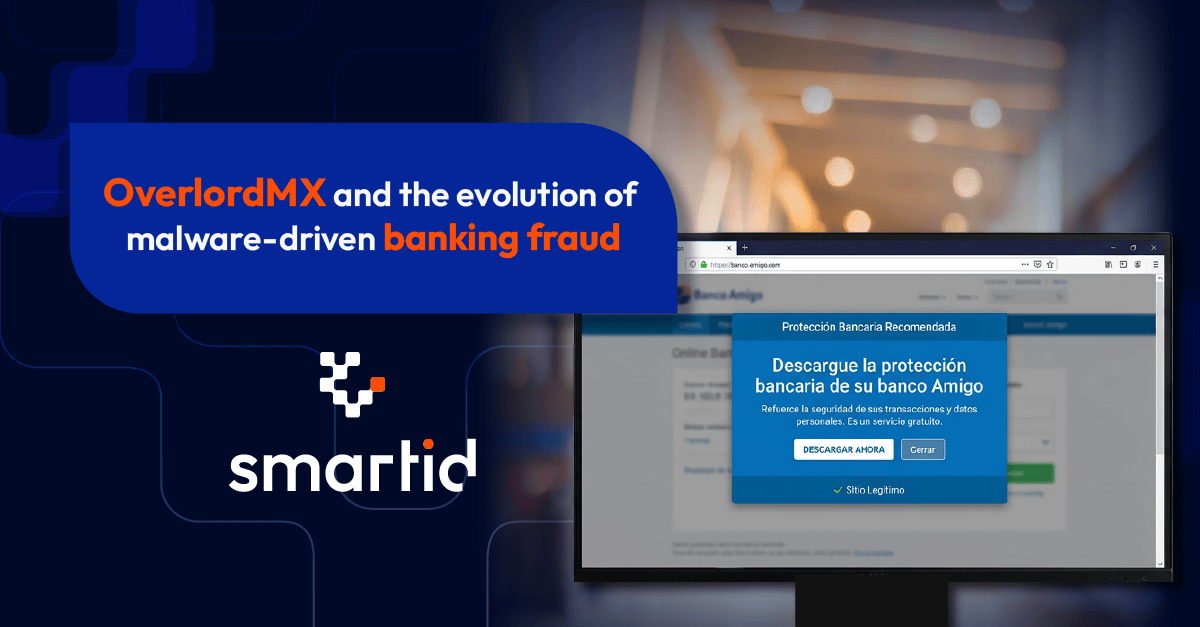
OverlordMX and the Rise of Session Hijacking in Modern Banking Fraud
By SmartID · fraud
_Banking trojans are evolving far beyond credential theft._
_New malware operations such as OverlordMX are part of a growing wave of threats focused on session abuse, browser manipulation and authenticated fraud against financial institutions and digital banking users._
_The objective is no longer simply stealing usernames and passwords. It is hijacking trust after authentication has already been completed._
# What Is OverlordMX?
OverlordMX is associated with malware campaigns targeting banking environments through credential theft, browser compromise and session manipulation techniques.
Like many modern banking trojans, the threat does not rely exclusively on malware execution alone. Instead, it combines phishing infrastructure, browser abuse and session-level persistence to operate within legitimate authenticated environments.
The campaign demonstrates how modern fraud operations increasingly focus on inheriting trusted digital sessions rather than bypassing authentication itself.
This makes detection significantly more difficult for organizations relying primarily on login-based security controls.
## Why Session Abuse Changes the Fraud Model
Traditional fraud prevention strategies were designed around authentication.
The assumption was simple:
if the credentials are valid and MFA is completed, the interaction can generally be trusted.
Modern banking malware challenges that assumption completely.
With session hijacking and cookie theft, attackers can inherit already authenticated sessions and continue operating as legitimate users without triggering traditional authentication alerts.
From the system perspective:
- the credentials are correct
- MFA was approved
- the session already exists
- the browser appears legitimate
But the identity behind the interaction may no longer belong to the legitimate user. That is what makes session abuse particularly dangerous for financial services.
## How Modern Banking Trojans Operate
Modern malware campaigns increasingly combine multiple attack layers simultaneously.
These may include:
- phishing campaigns
- malicious browser injections
- credential harvesting
- session cookie theft
- browser spoofing
- remote session monitoring
- transaction manipulation
Some malware families also monitor user activity silently before initiating fraudulent actions, allowing attackers to imitate legitimate behavioral patterns and reduce the probability of detection.nThe browser itself becomes a critical attack surface.
Because once attackers gain visibility into session activity, they no longer need to continuously compromise authentication systems. They simply operate inside trusted environments.
## Why Traditional Controls Are Losing Visibility
Many banking security models still concentrate heavily on the login event. But session-based fraud operates after authentication has already been approved. This creates a structural visibility gap.
Traditional controls may validate identity during onboarding or authentication, but often lack continuous visibility into:
- session integrity
- browser consistency
- behavioral anomalies
- device trust changes
- contextual risk signals during active sessions
As a result, attackers can maintain persistence within legitimate sessions while appearing normal from the platform perspective.
## The Shift Toward Continuous Session Protection
The rise of threats such as OverlordMX is accelerating the adoption of continuous identity and session protection strategies across financial services.
Organizations are increasingly incorporating:
- session monitoring
- device intelligence
- behavioral analytics
- browser integrity analysis
- contextual risk evaluation
- continuous risk scoring
Because modern fraud prevention can no longer depend solely on validating access once. Trust must be continuously evaluated throughout the entire interaction lifecycle.
## The New Banking Fraud Reality
Modern banking fraud no longer depends only on stolen credentials. Increasingly, it depends on stolen trust operating inside legitimate digital sessions. And that changes the security conversation entirely. The challenge for organizations today is no longer simply authenticating users.
It is continuously understanding whether the session still belongs to the legitimate identity behind it.
**Stay Ahead of Fraud**
[Stay informed about emerging threats and best practices for protecting digital channels. Subscribe to our weekly articles.](https://smartidsuite.ai/en/#contact)
[Let's talk about your current digital identity and fraud challenges. Schedule a meeting with our team.](https://smartidsuite.ai/en/articles/)