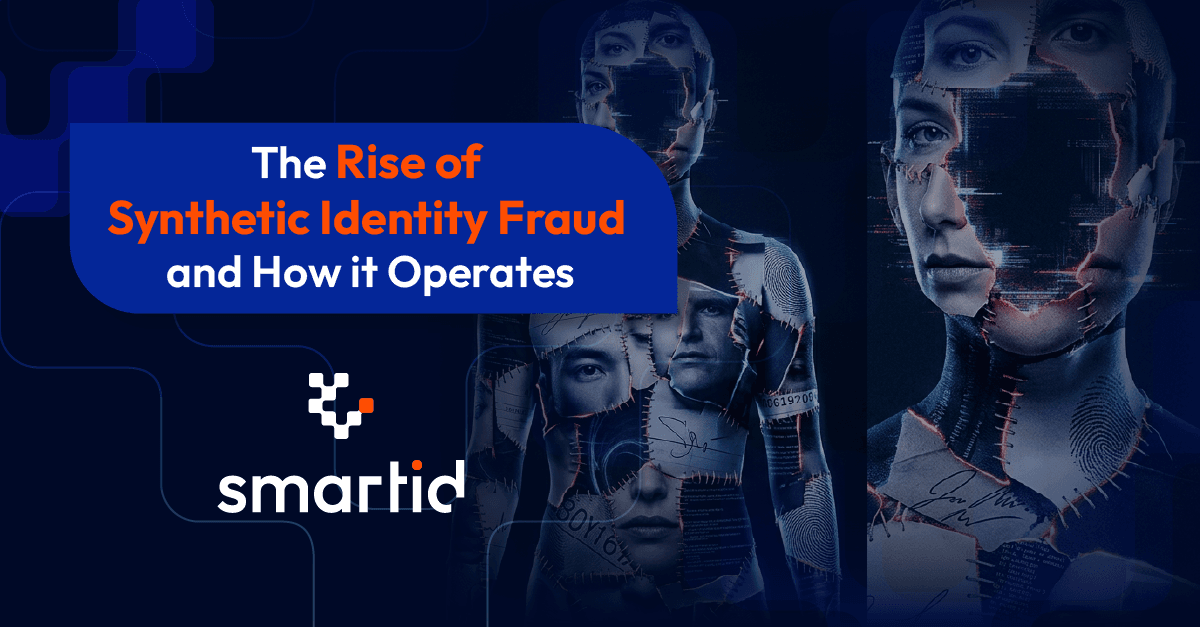
Synthetic Identity Fraud: The Most Dangerous Identity May Be a Person Who Never Existed
By SmartID · fraud
_When we think of identity fraud, we usually imagine a straightforward scenario: an attacker obtains stolen information from a real person and uses it to open an account, apply for a financial product, access digital services, or commit fraud in their name._
_But one of the most complex threats facing financial institutions, fintechs, and digital organizations today doesn't always involve a real victim. In many cases, the identity used to commit fraud never belonged to an existing person._
# What Makes The Risk Particularly Difficult To Detect In Its Early Stages
Unlike traditional identity theft, where a real person can eventually report that their data was used without authorization, in synthetic identity fraud there is often no direct victim to file a claim. The identity may not correspond to anyone. It was created from the outset as a tool for fraud.
For organizations, this presents a critical challenge: how to identify a fake identity if, on the surface, all its components appear valid?
# Identities that mature before attacking
One of the reasons this type of fraud is so dangerous is that it doesn't always seek immediate gain. In many cases, the synthetic identity is patiently built.
First, the profile is created. Then, an account is opened. Next, seemingly legitimate activity is generated. Later, financial products, lines of credit, benefits, digital services, or higher transaction limits are requested.
During this period, the identity can remain active for weeks or months before executing the fraud. In some cases, it may even behave like a normal user to gain trust within the institution's systems. This completely changes the detection logic.
Fraud no longer occurs solely at the time of account opening or in a specific transaction. It can be silently developing throughout the user lifecycle.
That's why fraud, security, and compliance leaders need to look at much more than static data. They need to understand relationships, patterns, behavior, and accumulated signals. Isolated signals are no longer enough.
A synthetic identity is rarely revealed by a single signal. The email may appear normal. The phone may be active. The device may have no obvious history. The IP address may not be blocked. The documentation may pass an initial review. But when these signals are analyzed together, the risk can begin to emerge.
A single device associated with multiple identities. An address used in multiple profiles with no clear connection. Emails with similar creation patterns.
Behavior Repetitive digital actions. Requests that follow an unusual sequence. New identities that try to build trust quickly. Profiles with little history, but with carefully structured activity.
The key is correlation. Synthetic identity fraud forces organizations to move from prevention based on isolated rules to a strategy based on identity intelligence. It's not just about validating whether a piece of data is correct. It's about understanding whether the entire identity makes sense.
## Impact for Financial Services and Digital Channels
For financial institutions, fintechs, insurers, digital retailers, and credit platforms, synthetic identity fraud can generate significant and difficult-to-classify losses.
In some cases, the impact can be mistaken for delinquency, default, credit loss, or operational risk. The organization may not immediately identify that the problem was fraud because the identity that requested the product appeared legitimate.
This also affects risk models. If a false identity manages to build a history, access products, and operate for months, it can contaminate future decisions and generate a false sense of trust.
The challenge increases when organizations seek to reduce friction in the digital channel. Legitimate users expect fast, simple processes without unnecessary obstacles. But fraudsters also leverage these same flows to insert fabricated identities. The key is to detect better, not simply to block more.
## How to Strengthen Detection
Detecting synthetic identities requires a broader view of digital identity. Organizations must combine signals from device, behavior, session, contact data, browsing patterns, activity history, and relationships between entities.
When these signals are observed in an integrated way, it is possible to identify inconsistencies that would not be visible in an individual review.
In an environment where an identity can be fabricated from scratch to appear trustworthy, trust cannot depend on a single validation. It must be built continuously, based on context, correlation, and behavior.
Because the most dangerous identity can be the one that never existed.
**Stay one step ahead of fraud**
[Subscribe to our weekly articles on emerging trends, fraud, and digital security. We share clear, actionable insights for leaders in security, fraud, compliance, and digital channel transformation.](https://smartidsuite.ai/en/articles/)
[You can also schedule a session with our specialists to learn how SmartID can help your organization detect synthetic identities, reduce friction, and anticipate risks before they become losses.](https://smartidsuite.ai/en/#contact)